
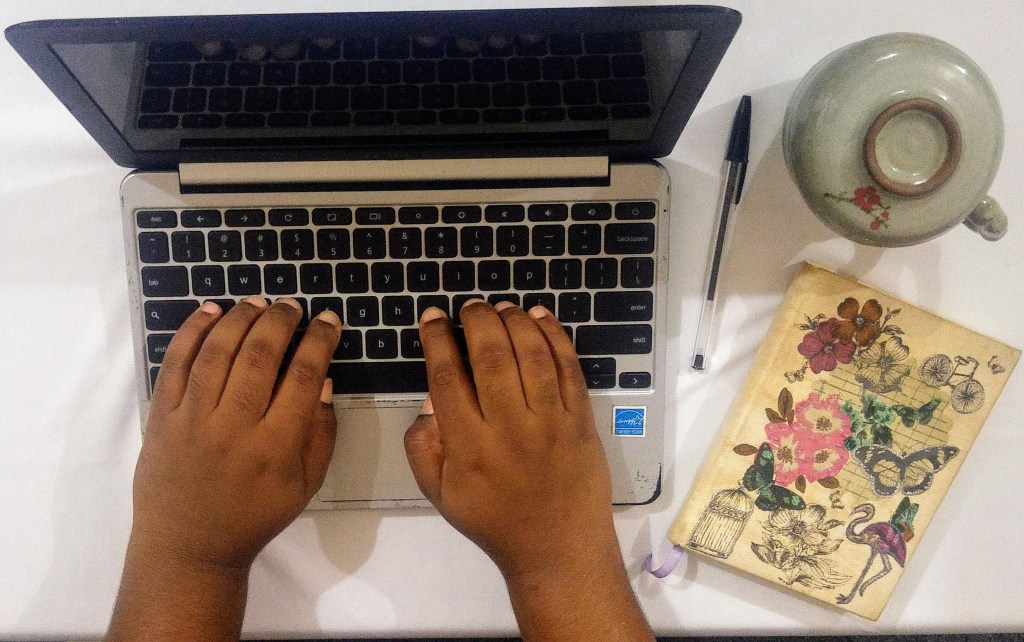
Last week, I participated in four virtual writing workshops hosted by the Hurston/Wright Foundation and The Fold Festival of Literary Diversity. From my laptop, I was able to connect with participants in countries such as Canada, Chile, India and the US while gaining insight into process, technique and more from established poets and writers. In one week, I workshopped with Hanif Abdurraqib, Chet’la Sebree, Canisia Lubrin, Billy Ray Belcourt and Helen Knott. These workshops provided a comfortable space for me as the world reels through the Covid-19 pandemic when it can be hard to maintain comfort, particularly mentally. I also learned a few things.
- The Internet is an important tool for maintaining and creating community.
The pandemic has forced us to curb human interaction. It’s hard to imagine how we would have maintained and created community without the Internet. Each workshop I participated in had over 200 participants – a feat that may not have been possible if they were hosted face-to-face. Creativity is a coping mechanism for many and we’re able to share and get feedback instantly as well as access experts in more liberal formats. We are also creating communities we didn’t know we needed or even existed.
“Genius is external. It’s time and effort that lead to mastery.” – Helen Knott
2. There’s no right way to be a writer.
Sebree shared that she started the Masters of Fine Arts (MFA) immediately after undergrad and didn’t feel prepared for the program. Knott is professionally trained as a social worker and started writing as a part of therapy. Before poetry, Abdurraqib was the lead singer in a band and started out in spoken word. So while education is important, you don’t have to have an MFA to be a writer. According to Sebree, engaging with artists outside of poetry and creating community is just as important.
3. Quality trumps quantity.
“I don’t like to think about writing as a hierarchy of productivity…that’s a disservice.” – Hanif Abdurraqib
This point was made by Abdurraqib during Q&A and I was relieved to hear him speak about productivity through a forgiving lens. He tied hyper-productivity to capitalist ideology and pointed out that a person can write only five times a year, but still have more to offer than someone who writes daily. In most of the writing workshops/circles I’ve been part of, hyper-productivity has been the mantra. So there was always guilt or lack of commitment associated with not producing daily. I think Abdurraqib’s advice isn’t just applicable to writers, but all professionals who feel pressured to constantly produce. This is not to say writers shouldn’t be reading, editing and focusing on keenly developing craft, but we need to respect rest as part of the process.

4. There’s no shame in using familiar language.
Writers and poets are often bogged down by critique that admonishes the use of cliché, but it’s important to distinguish cliché from what Abdurraqib calls familiar language. Familiar language can add percussive or rhythmic quality to work particularly through repetition. Familiar language can also be the language that we have been taught is not poetic – our local dialects or slang – and we have to work towards removing shame surrounding their usage.
“Music is the anatomy of poetry.” – Canisia Lubrin
5. Understanding how to identify and manipulate metaphor is key to clarity in writing.
Belcourt and Lubrin spent a good bit of time reviewing metaphor and pushing participants to go beyond what is learned in high school to understand metaphor as the “mind’s exploration of error.” According to Lubrin, metaphor doesn’t give explicit parameters, but opens up opportunities for engagement. A poem can be interpreted in many ways and it’s for the writer to start the discussion.
“My goal with writing is creating a pathway to liberation.” – Helen Knott


Leave a Reply