
On Sunday, videos of a group of mostly children being detained by police in Trinidad & Tobago went viral. While their offense of breaking the current Coivd-19-related Public Health Ordinance is serious, the aggressive policing displayed and the exposure of the children’s identities were discomforting. The images of the Commissioner of Police (COP) and other heavily armed officers bussin’ the children’s lime evidenced the myriad ways black people are actively criminalized be it fact or fiction.
How is the buss lime connected to Buss Head? The answer lies within media representation. In July 2017, shortly after the Buss Head music video was released, I wrote the review below. As I watched clips of the detainment of these children, I couldn’t help but find similarities between the treatment of the young, black boys in both the music video and the police footage.
The children/teens went to their local beach (on Saturday it appears) and filmed themselves cursing the COP, the Corona virus and generally acting up as people in their age group are wont to do. The next day, the COP lead a team to the filmed location and apprehended the children, who were still hanging out apparently. The police footage show the children being made to lie sprawled, face-down on the ground while being searched and having large guns pointed at them. The response was harsh when compared to the demographic and the imagery all too familiar.
Here’s my previously unpublished review:
In the week since the release of the official video for Machel Montano & Bunji Garlin’s collaboration, Buss Head, I’ve read nothing but positive feedback. That’s beautiful because too often in T&T we’re quick to criticize or fail to recognize the achievements of our stars. Yet, as beautiful as the collaboration and response to it may be, we need to have a serious conversation about the ways in which the video reinforces negative stereotypes of young black men and fails to portray the structural violence affecting certain communities.
Released for T&T Carnival 2017, Buss Head was a welcome, surprise collaboration demonstrating that Montano and Garlin were able to squash their long-standing beef. An ode to Kalinda – the stickfighting tradition – Buss Head reached beyond soca music’s party aesthetic to highlight an important part of Carnival history. The video premiered internationally on The Fader and has garnered over 100,000 views (Update: 844,095 views as of 20/04/2020). As Garlin wrote in his description:
“The song’s backstory is basically from the view of the Stickfighter; stickfighting is a martial tradition that came to Trinidad from West Africa. The stickfighters ended up with the most important role, as in 1884 a British contingent tried to abolish Carnival in Trinidad, but they were defeated by the stickfighters. It translates into my story and your story and everyone’s story, because we all have that battle to face to save something.”
In February, there was even a discussion forum on stickfighting that featured Keegan Taylor and Rondel Benjamin of the Bois Academy – a nonprofit organization focused on teaching indigenous martial arts – alongside Montano and Garlin.
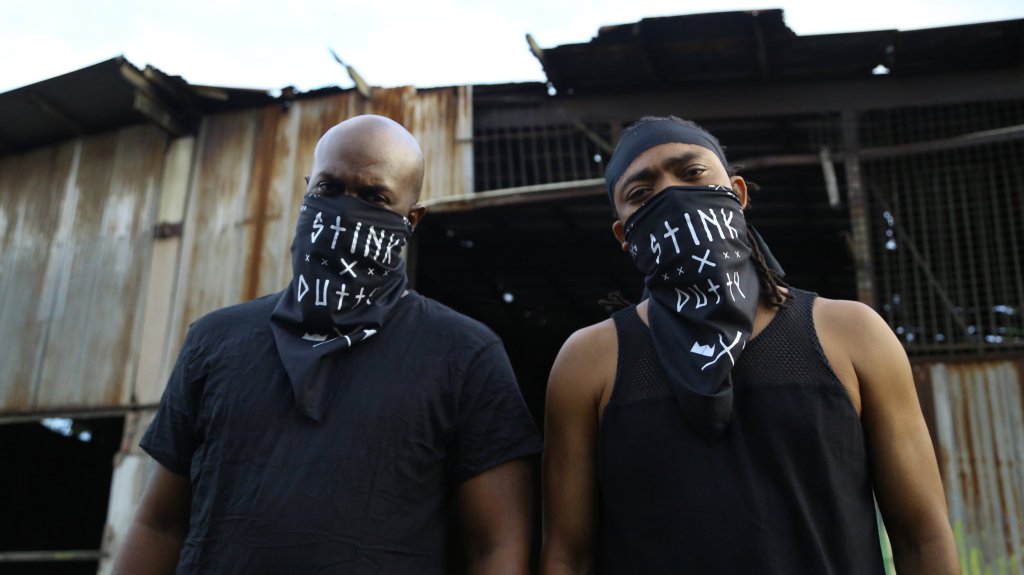
The video – directed by Jerome Guiot – tells the story of a troubled youth finding a positive outlet for his negative energy through Kalinda. The story is set in Sea Lots – an east Port of Spain neighborhood usually associated with poverty and crime. The Boy, played by Richie Meade, wakes up in a dilapidated bedroom and proceeds to go on a violent, day-long rampage in the community. At the end of the day, The Boy ends up in a gayelle (stickfighting ring) where he meets Montano and Garlin. They become his trainers and essentially spirit guides helping The Boy to direct violent behavior to martial arts.
Buss Head was one of my favourite tunes for Carnival and on the surface, I like the idea of the video – it’s a coming of age story showing The Boy discovering his African heritage. But ultimately, without a symbol or demonstration of the effects of structural violence, his character becomes the violent, criminal stereotype of the black man.
Black men, particularly those with darker skin like The Boy, have been stereotyped as violent and criminal in the media for at least a century. An early example is the 1906 Atlanta Race Riot, when black men were wrongfully accused of raping and murdering white women in the local newspaper. The articles gave birth to racist mobs leading to 26 deaths. These stereotypes are also visible in early cinema, like in the film Birth of a Nation, while modern films such as Fist Fight and Get Hard also bolster these tropes. These aren’t local examples, but where local data is absent I use the prevalence of American media in T&T and the similarities in histories of slavery and colonialism as a guide.
Structural violence is a term coined by Johan Galtung that can be defined as the systematic exclusion of a particular section of society resulting in mass inequality. Structural violence harms people by preventing them from access to basic needs. Institutionalized classism, racism and sexism are examples of structural violence, which is differentiated from direct or physical violence because it is not immediately visible, yet the two are interdependent.
In The Boy’s story, physical violence is clearly displayed, but as a resident of the historically impoverished Sea Lots, this story can’t be told without interrogating institutional responsibility. In his 2010 study of school violence in T&T, Dr. Hakim M. A. Williams observed that interventions to address issues of violence in schools failed to take structural violence into consideration. Williams noted:
Barely anyone problematized the dual education system that exists in Trinidad that was inaugurated during the colonial period (i.e. the top academically performing schools were built prior to independence and the students who score the highest on the national exams or whose families have the socio-cultural capital/connections are assigned to these colonial schools). Barely anyone problematized how many schools built in the independence era (to facilitate mass education) struggle with shortfalls in material and human resources.
The schools he studied were in the Laventille area as is Sea Lots. To be sure, the socio-cultural capital/connections Williams mentions not only influence education, but also employment, access to State resources and general well-being. So most likely, The Boy didn’t just wake up angry as the Buss Head visuals lead us to believe. [End]
Media representation is important because it can shape and/or reinforce societal opinions. In as much as the COP tried to be compassionate in his press release on the matter (noting that he opted not to arrest the children) and posting of the video (where the children’s faces were blurred), the fact that they were this aggressively policed and recorded as minors is problematic. The videos managed to still be leaked with the children’s faces all over the Internet in addition to the public shaming of their behavior. The question is: if these were children of a different race or class, would they be treated the same way?


Leave a Reply