
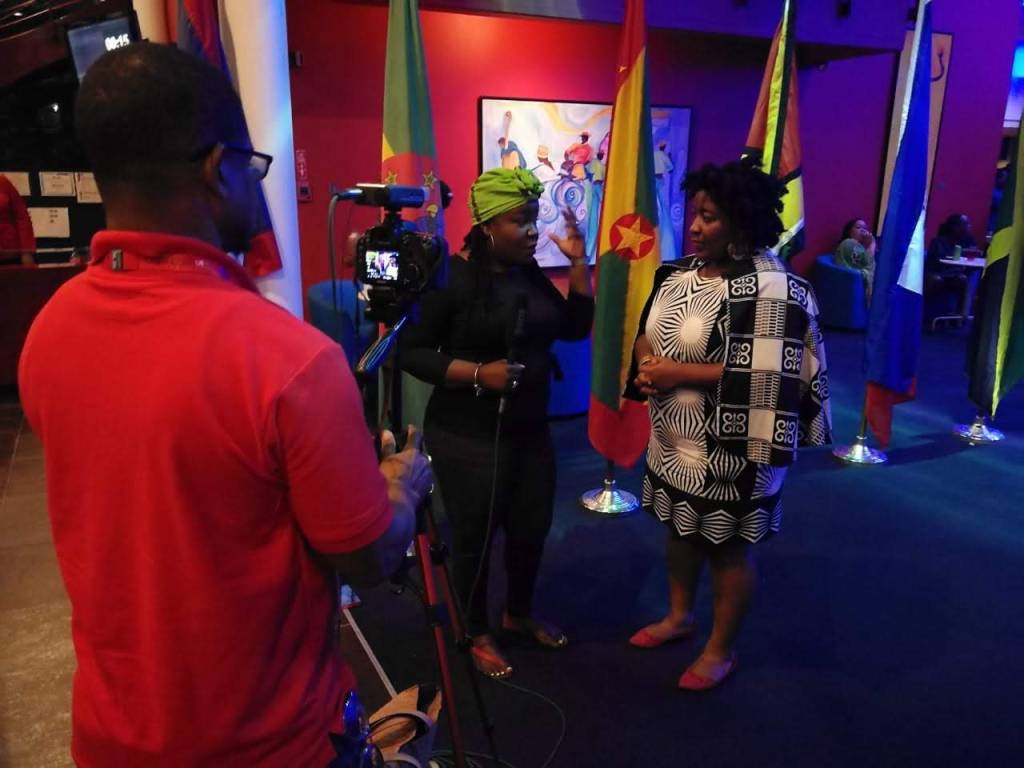
Last year, I was invited to read poetry at Carifesta, which was held in Trinidad & Tobago (T&T) in August, 2019. My experience was amazing, demonstrating the power and beauty of Caribbean unity, but also the complexity of that “togetherness.”
Carifesta – the Caribbean Festival of Arts – is a biennial event organized by the Caribbean Community (Caricom) states. The first iterations of the festival were held in 1972 arranged by Guyana’s then president, Forbes Burnham, in response to calls by artists for a regional conference.
The festival showcases arts and culture from Suriname to The Bahamas and every island state in between. In addition to music, dance, theater and visual arts, there’s also symposia – an intellectual tradition that is key to the festival which I wrote about for UWI Today.
Apart from the honor of performing, experiencing Carifesta felt like island-hopping and renewed a sense of pride in my heritage. The organizers created replicas of public spaces and statues from nearly every island – I was able to walk from the Starbroek Market in Guyana to the Unknown Slave Memorial of Haiti and even stroll down the Malecon of Cuba. It wasn’t just the replicas, there was food, of course, rum, whispers and shouts of Patois, Kreyol, Spanish and French. As someone who can/does identify as Caribbean-American, it was also comforting to see the Diaspora represented to speak about the Caribbean experience in North America.
I felt like I was part of something massive. I felt like We, with a capital letter, like I&I, like there was a transcendence of petty and petulance. This was day one.
Before my second performance, I was backstage waiting to take the podium while the Guyanese National Dance Company performed. To set the scene: The event was called Umoja – Thicker Than Water and co-hosted by the Emancipation Support Committee (ESC). The ESC is responsible for commemorating the abolition of slavery in T&T. Umoja is Swahili for unity and the theme sought to highlight our collective African heritage in the Caribbean.
And as the dancers slid gracefully across the stage to a Bob Marley medley, a Trinidadian sitting next to me said, “Why are they playing this Jamaican music?” A colleague responded, “Well, this is Carifesta, as in, Caribbean.” The man, who thought the dance troupe was local, went on xenophobic rant about why T&T is so backward and people taking over our events and by extension, our culture.
The idea that our shared histories are more important than the accents, waters and syncopations that separate us, was lost on him. It was upsetting, but unfortunately, not surprising and not a sentiment I haven’t heard before. When I was in college, Caribbean Airlines acquired Air Jamaica. A Jamaican classmate said T&T was trying to “take over my country.” A friend in The Bahamas has told me about the xenophobia Haitian immigrants experience there as well and I’m sure it’s not hard to find similar situations and sentiments Caribbean-wide.
This fear of other is a lingering colonial ideology, though; we need to dismantle it for events like Carifesta to be real – to extend further than good feelings, but to actual empowerment.


Leave a Reply