
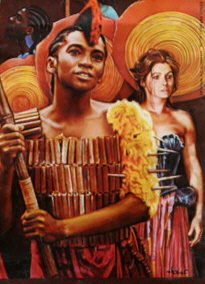
The United Nations has declared 2011 as the International Year for People of African Descent (IYPAD). According to the IYPAD homepage, “In proclaiming this International Year, the international community is recognising that people of African descent represent a distinct group whose human rights must be promoted and protected.”
That’s all well and good but my main problem with this declaration is that it was not formed out of a collective impetus, feeling, or vibration from African descendants around the world coming together to “eff the ineffable”. This declaration was formed by a governing body, a UN Working Group of Experts, by people with titles and positions many of whom are not of African descent. This is a fundamental problem even as the UN seeks out non-profit organizations and community leaders already working in Africa and the diaspora.
Let’s look at it this way: there are two films that come to mind which deal with slave revolts against Portuguese colonisation, Burn! (1969) and Quilombo (1986). Burn! was set on a fictional island while Quilombo is an interpretation of a true story. A quilombo in Brazil was similar to maroon or cimmaron communities in other parts of Latin America and the Caribbean. These villages were where the escapees (slaves) resided.
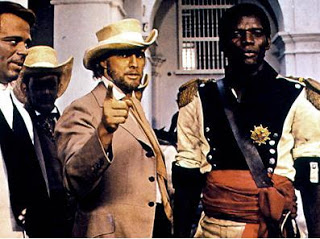
One of the main differences between these two movies is the initiation of the revolution and consequently the mentality of those revolting. In Burn! a British “secret agent” Sir William Walker is sent to the island with instructions to overthrow the Portuguese. Walker does so by persuading a group of slaves, lead by his newly acquired African protege, Jose, to fight for freedom. He points out to the enslaved that they should not in fact be enslaved. It almost appears as if he points out the mere fact that they are enslaved which is why when the revolt “succeeds” Jose retains Walker as an adviser. Of course, Walker was still manipulating governments, white farmers and politicians maintained the important power and Africans on the island remained sugar cane labourers under even worse conditions than slavery.
In Quilombo on the other hand, there was no question as to the humanity of those formerly enslaved. There was no waiting for someone to come from Britain and say “You are a slave do something about it” Those involved took their freedom by any means necessary, cliche intended, and built independent, prosperous communities without slavery.
So an IYPAD coming from the UN to the African people rather than from the African people to the UN will remain a symbolic gesture until the tables have turned. The UN is saying that slavery was wrong and its impact on the African community needs to be acknowledged, key words are being used in their documents about discrimination and justice, but at the same time the UN is not taking critical action towards “righting past wrongs” against Africans.
Cultural symbolism is strong and dangerous. With this IYPAD the UN can detract attention from their history of favoring US imperialism. A good example of this is the current situation in Libya where the UN Security Council used a carefully worded “no fly over zone” measure that allowed the US and its allies to proceed with bombing attacks. The UN is simultaneously allowing the US to kill African civilians while proclaiming a year dedicated to their celebration and uplifting? Similarly, the UN is not taking action against AFRICOM – the US military’s increased aggressive and unsanctioned presence on the continent.
Seeing as the UN is largely a US entity, what could be more symbolic than declaring an International Year for People of African Descent during the term of the first US President of African descent? The year will culminate right as Obama’s re-election campaign heats up. This probably won’t have much weight on his campaign but he will continue to be endeared the world over as he was when receiving the Nobel Peace Prize…while at the head of a government fostering war in the Middle East. Hmm…
Africans and African descendants do not need the UN to facilitate merely symbolic celebrations. In 1951 William Patterson led a delegation to the UN charging the US government with genocide. Malcolm X also planned on taking a delegation before the UN to charge the US government with human rights grievances. This is the vibe that should be coming from “the people” to the UN.
The “The Liberation Imperative of Black Genocide” by Joao H. Costa Vargas speaks about the present-day relevance of Patterson’s work and the current genocide of black people around the world. Genocide, as Vargas points out, is defined by the UN themselves as “any of the following acts committed with intent to destroy in whole or in part, a national, ethnic, racial, or religious group such as the following:
- Killing members of the group
- Causing serious bodily or mental harm to members of the group
- Deliberately inflicting on the group conditions of life calculated to bring about its physical destruction in whole or in part
- Imposing measures intended to prevent births within the group
- Forcibly transferring children of the group to another group”
As Vargas also points out: “Dimensions of antiblack genocide in the contemporary United States include mass imprisonment, police brutality, high infant mortality, early death (of children men, women, and the elderly), deficient medical treatment, lack of competitive education and economic opportunities, everyday violence in the inner cities, and chronic depression” This model of oppression is mirrored in many other countries with large populations of African descendants and minority ruling classes.
IYPAD is analogous to silence and inaction on the concrete issues facing people in the diaspora. Its like Mr. Vargas says, “White supremacy and antiblack racism are genocidal. Complementing their most obvious manifestations, white supremacy and antiblack racism also work through silence, inaction, and ignorance. White supremacy and antiblack racism happen both because of what we and others do as well as what we and others do not do. Consequently, silence, inaction, and ignorance are as genocidal as the most overt racist acts and thoughts. What is to be done? A crucial step in the organized struggle against antiblack racism in Brazil is to denounce genocide that is facilitated though hegemonic whitening ideals and the genocide that is more direct and causes the physical and civil death of African American – here understood as people of African descent in the Americas – through multiple forms of marginalization”


Leave a Reply