jotted down a few thoughts in a notebook while travelling week before last and i’m finally getting to put them up here. hopefully i won’t be guilty of belaboring a point. this may turn out to be one post in many on my thoughts about rAcE! and t&t as there are so many pockets with musings on the topic and i don’t know where to start or end my responses and get my thoughts out. this may be the first and last post on this topic for those very same reasons:
this song is broad and timeless. makes me want to challenge myself and relate it to every blog post.
anywhere yuh turn somebody chanting to we
vote for we and we will set you free…
somebody going to end all dis talk about race
but dey cyah tell me dat with a straight, straight face
big, big men dying de crime cyah solve
a madman rant is mih only resolve
ah hear de madman bawl
as he lie on a wall
he say, “dis is it, dis is it, dis is it, i’ve been hit”
but no time to give up, brother, no time to quit
a chant of a madman in this tale from a strange land
it was a chant of a madman, in this tale froma strange land
give me de chant of de madman, is de only salvation
—- “Tales from a Strangeland: Crossing the Bridge, A Madman’s Rant” David Rudder 1996
there is a lot of talk now on the island about race. indian and african divide. this morning(march 31st) sat maharaj was on the tv being interviewd about nizam mohammed. mohammed is the chairman of the Police Service Commission (PSC) who recently said there were too many africans in the police service’s upper echelons. he also said that “indians needed protection too” that is to say that african police officers are only interested in protecting one group of people and that the police service should adapt as banal a mindset as: african officers protect africans, indians protect indians. rather than an approach that serves all people of the country and humanity.
the other thing about him making these comments is that it shows he has concerns not entirely pertinent to matters facing the police force such as corruption, salary increases, resources like proper cars and stations to work from, a computerized system for records. all far more urgent issues than ethnicity at this junction. this is not to say that everything is peaches between the african and indian but we’d be better off addressing other issues first.
and if he was making a “race” statement, what kept him from mentioning the foreign white police commissioner and his deputy? why not speak about their looming presence and symbolism of colonialism? not to mention the fact that their race and foreign-ness warrant them unprecedented salaries for their positions. recently, mohammed has asked the public to remember that he was an advocate of black power during the 1970 revolution. you’d think a black power advocate would call the government to task about the commissioner. you would also think that a black power advocate would (re)call some of the ideology of the time period.
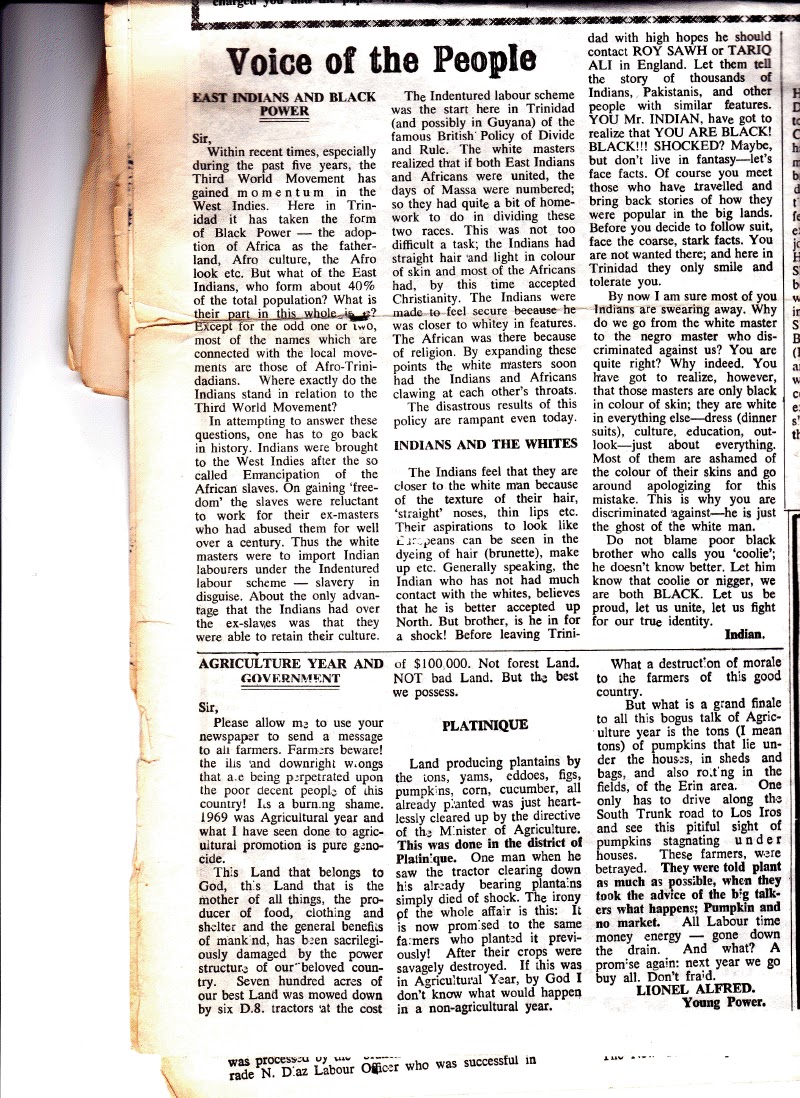
in a feburary 1970 copy of
the vanguard newspaper (clr james was a contributor along with many other revolutionary theorists) a letter to the editor was written by an annonymous person of indian descent. the writer expressed some of the same ideals walter rodney advocated on his return to guyana. he spoke to a history that we all need to remember and speak about more constructively:
“The Indentured labour scheme was the start here in Trinidad (and possibly Guyana) of the famous British policy of Divide and Rule. The white masters realized that if both East Indians and Africans were united, the day of Massa were numbered; so they had quite a bit of homework to do in dividing these two races. This was not too difficult a task; the Indians had straight hair and light in colour of skin and most of the Africans, had, by this time accepted Christianity. The Indians were made to feel secure because he was closer to whitey in features. The African was there because of religion. By expanding these points the white masters soon had the Indians and Africans clawing at each other’s throats. The disastrous results of this policy are rampant even today.”
that doesn’t sound like a like a 41-year old letter. to read more enlarge photo below.
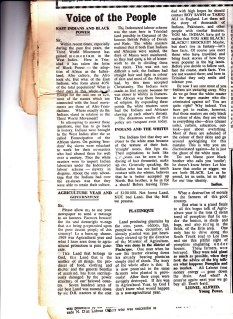 |
| Annonymous letter in the 1970 Vanguard Newspaper. |



Leave a Reply