
For the sake of time and the Twitteratti, who in this day and age for the most part cannot take long, heavily cited blogs, I will try to keep this short and get straight to the point: Buhwamoder,*** the man behind the song “Bend Right Over,” is a modern-day minstrel; an Arab man in black face. Yes, they do still exist, but wha de modda?
The other day a friend and I both agreed that even though one shouldn’t dwell in the past, that does not mean that one forgets. The advent of Buhwamoder is a clear example of why it remains important to remember. I tortured myself when writing the last blog by watching his interviews and music videos. One of the comments under a YouTube video of Buhwadmoder said, “a white boy acting like ah indian whos singing like ah black man…peace”. This person was getting at something whether they knew it or not.
Minstrelsy was a form of theater that developed in the US in the 19th Century in which white performers took and interpreted African-American folk tradition. “A strong white male fascination with black men and black culture, that is to say, underwrote this popular expropriation. Blackface performers were conspicuously intrigued with the street singers and obscure characters from whom they allegedly took material and fashioned to racist ends…From the start it appeared that a sort of generalized illicitness was indeed one of minstrelsy’s main objectives.” (Lott 25). In other words, minstrelsy was concerned with one supposed area of black entertainment culture and depicted it negatively.
This type of minstrelsy (for there would be black minstrels as well) has experienced new found growth in commercial hip-hop and as such is rearing its ugly head in the “Third World” where mimicry of American pop culture (i.e. hip-hop) heavily permeates music industries. A note should be made that the main consumers of commercial hip-hop in the US – with its monotonous, stereotypical, degrading, negative, I can go on with the adjectives, portrayal of black people – are white suburban teen-age boys and not black people like you are made to think. It should also be noted that the owners of the corporate music companies who commission the hip-hop minstrels and profit the most from their feigning(?) ignorance and niggerisms are also white males, though older and wealthy.
Historically and presently, minstrelsy was overly concerned with black male sexuality and aggression (Twitteratti please don’t skim this quote. I beg of you!):
The early emphasis was on what film theorists have called ‘spectacle’ rather than narrative. The first minstrel shows put narrative to a variety of uses, but it relied first and foremost on objectification of black characters in comic set pieces, repartee, physical burlesque. The primary purpose of early blackface performance was to display the “black” male body, to fetishize it in a spectacle…In this affair “blackness” provided the inspiration as well as the occasion for preposterously violent, sexual or otherwise prohibited theater material… (Lott 28)
In other words, white actors of the time lived out the most extremes of their patriarchy on stage and attributed it to black culture. It is the same way that hip-hop culture gets blamed today for being violent and sexist in and of itself while there is no discussion of the many ways hip-hop culture mirrors American (white) cultural values.
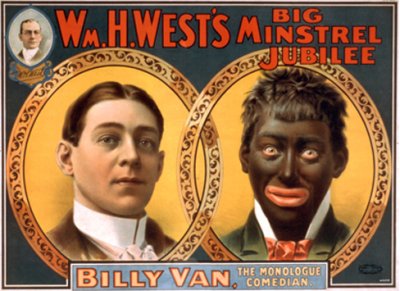 |
| Common 19th Century Minstrel |
Now back to Buhwamodder. I needed very few clues to determine that he was a minstrel. First there was the “ras;” the hand gestures when he spoke; the way he spoke; his “Indian surname” which was considerably long and fake sounding; his reference to attracting the ladies with his big shiny chains; the video where he “makes” the ladies bend over with an interlude where he stimulates a sex scene with one of the dancers/models. I have seen this video on BET many times and apparently Buhwamoder watches BET as well.
He did however redeem himself in my eyes with one aspect: Buhwamoder has not forgotten. In T&T, there was white minstrelsy as well although it did not take on that specific name and could be seen best during the Carnival season (I know I’m demanding, but don’t skim these quotes either!)
Thus [by the 19th Century] already there was an acculturation process taking place with the French adopting African dances, instruments and dress to give vent to their festive moods and to provide the fire for their feasting, dinners and balls. By dressing in the garments of enslaved domestics and field laborers, the French were actually mimicking the Africans’ oppressed state; they were making fun of the degradations to which Africans were subjected through enslavement. (Liverpool 129)**
In this sense, minstrelsy was part and parcel of the global system of oppression: “…in Louisiana, as in Trinidad, the French assimilated some of the social patterns and cultural traits of Africans to express joy and find fulfillment in the carnivals of the pre 1838 era. However, the fact that they liked the music [Bamboula & Kalenda] did not stop their hatred or oppression of the Africans” (Liverpool 130)
Buhwamoder is playing mas this ca’naval season; no longer necessary to pick up the stick to fight with the Kalenda music, he has donned a microphone to sing soca.
*”Love & Theft: The Racial Unconscious of Blackface Minstrelsy” Eric Lott
** Rituals of Power & Rebellion Hollis “Chalkdust” Liverpool, PhD
***Trinidadian “Soca artiste”


Leave a Reply