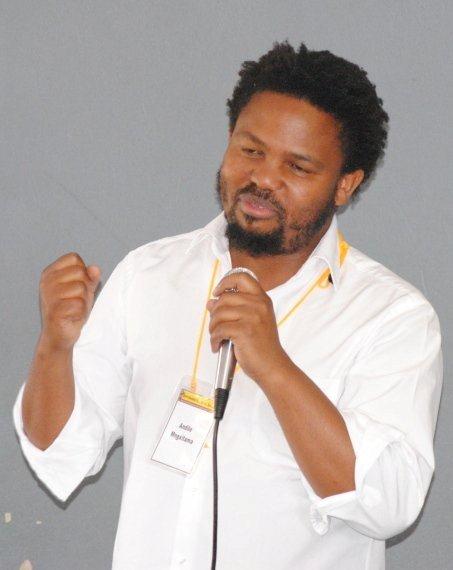
February has now come to be known as Black History Month (BHM) in the US. Initially Negro History Week, since 1915 the celebration of black achievement pioneered by Carter G. Woodson has transformed into a month of activities. Before his death, Woodson himself had become weary of the commercial aspects of BHM. He advocated that the study of black history be a year-round movement. Although there are now BHM celebrations all over the Diaspora, it does not seem that black history has 365-day shift Woodson envisioned. The presence of BHM around the world is important because there has been in recent years a global push towards multiculturalism – an agenda which it’s likely that events such as BHM would boost. South Africa is one “multicultural” society where pockets of BHM celebrations can be found. This interview with Andile Mngxitama, South African author and activist, questions the value of current commemorations of BHM.
1. When did you first come to know about the Black History Month (BHM) concept?
Really don’t remember, but it’s a concept which has gained recent currency this side of the Atlantic. I think the same small but dedicated black activists and thinkers who have brought Kwanza here have something to do with it.
2. Do they celebrate BHM in South Africa? Why or why not?
In South Africa small groups in the community try to do some things around the date, but it’s all symbolic. You know with Obama becoming president the same people who think great of Mandela kind of wanted to build more connections and so on. I’m not sure about the politics of the thing and I’m a little dismissive really. However, there is no official celebration of the month from the government side.
3. Does BHM mean anything to you even with your “unconventional” views of the month? Can you talk a little about your “unconventional” views?
I think I’m only “uncoventional” in the sense that Malcolm X was unconventional: a black person demanding justice instead of begging for inclusion. Myself and some people influenced by the black radical thinking of Biko, Fanon, Malcom X and others find great inspiration in the Black Panthers and the Black Liberation Army, Haiti’s unparalleled 1804 slave revolt, and we are forever moved and humbled by the fighting spirit of sister Assata Shakur. So that is the sense in which one can think of me and others as unconventional. Of course, we think of ourselves as normal black people who see the black condition for what it is.
My own issue with BHM is that it has been commercialized and increasingly ghettoized. We are all doing white supremacist history then we reserve one month in a year to remember black history. I also have issues with “history junkies” who sometimes go by the name Afro-centrists or Egyptologists – you know these people who love the pyramids too much. I call them the “when we were kings and queens” people. They have nothing useful to say about the current black condition. I’m hostile to these sorts of celebrations of African former greatness; it consumes energy and takes us away from the hell we live in right now.
Of course, this doesn’t mean we must not use our black history to help us understand the contemporary and fight. We need to remember Nat Turner you know! I mean, Mumia Abu Jamal is a living symbol of that kind of history, but also we must remember the Uncle Toms, the Mandelas and the Obamas! They are not a new phenomena. History teaches us that they come from a long line of house negroes! And you know what Malcom X says about them, they are part of the black history we must reject.
4. This might be a silly question, but do they teach black history at schools in South Africa? (If they do, is it accurate? If not, why do you think so?)
South Africa is a white country run by blacks. I was just the other day having a big history discussion with my niece. You know, she is being taught that whites arrived here and found empty land and so on. No, we don’t actually teach black history. We teach Uncle Tom history. I think Kwame Toure would have called it Honkie history!
5. How do you think black history month correlates with the multiculturalism/rainbow nation agendas?
I have alluded to the Uncle-Tommist undertones of the whole venture. What parts of black history are being recalled? Why is it silent on the likes of Garvey? The Mau Mau or Poqo here in SA? These things are ideologically loaded and we must enter the contest, reclaim space for black radicalism!
6. In an ideal world, I think BHM would be a non-issue because blacks would be included where necessary and not have to assert that they too have humanity and history. What is your take on that?
Indeed. For now we are on our own! But we must not seek inclusion. We must seek obliteration of the current reality; make white supremacy history!
Mngxitama is a columnist for the Sowetan. He writes regularly for various other local papers. He is the co-editor of Biko Lives: Contesting the Legacies of Steve Biko (2008). Through his writings he questions the extent, nature and impact of the democratic process since the first elections in 1994. He was one of the founding members of the Landless People’s Movement in 2002. In 2010, Mngxitama was one of the coordinators of the September National Imbizo, a conference held to unify Black struggle in South Africa, which was held in Soweto. He was recently featured in the UK Guardian as one of the leading Black thinkers in South Africa today. To read more of his works you can also purchase the journal New Frank Talk: Critical Essays on the Black Condition online.


 Zahra Gordon
Leave a reply to RAS MENELIK AZANIA Cancel reply